What Does Laser Resurfacing Do for the Skin?
Laser resurfacing sits near the top of most treatment menus in aesthetic medicine, and the name hints at the mechanism: it works on the surface of your skin, and on the layers just beneath it. What that translates to in practice is a more interesting question. The answer depends on which laser is used, how deeply its energy travels, and which concern it is asked to correct.
This guide explains what a resurfacing laser physically does once the energy reaches your skin, which concerns respond to it, and what the treatment realistically delivers over the weeks that follow.
What is laser skin resurfacing?
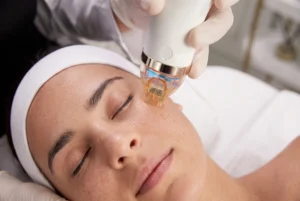
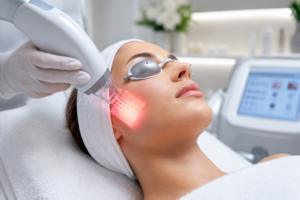
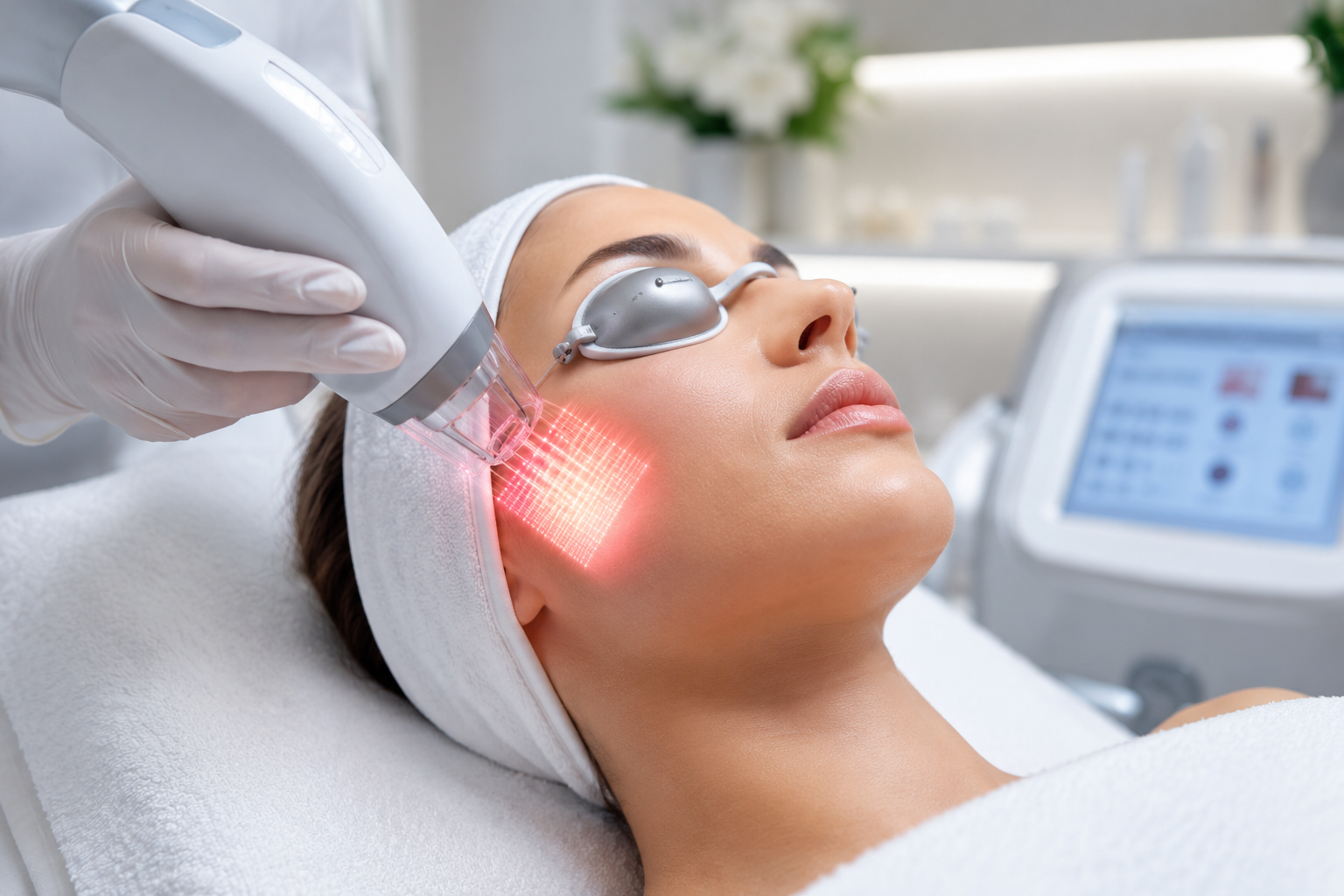
Laser skin resurfacing is a treatment that directs precisely controlled light energy into the skin to trigger renewal at a cellular level. Water in your tissue absorbs that energy and converts it to heat, which creates microscopic zones of controlled thermal effect in the treated area. Your body reads each of those zones as tissue that needs repair, and the healing response that follows clears out damaged cells while building fresh collagen in their place.
The clinical term for this approach is fractional photothermolysis, which describes the underlying design of most modern resurfacing devices. Rather than treating the entire surface at once, the laser divides its energy into a grid of tiny columns, leaving healthy tissue standing between them. That untreated tissue acts as a reservoir of healthy cells that speeds the repair of its neighbors, which is why fractional treatments recover far faster than the wholesale resurfacing techniques used decades ago.
How do ablative and non-ablative lasers differ?
Resurfacing lasers fall into two broad families, and knowing which one you are being offered tells you most of what you need to know about your results and your calendar.
Ablative lasers vaporize the outermost layer of skin, removing it so that new tissue grows in its place. They deliver the most dramatic correction for deep wrinkles and significant scarring, and they ask for a recovery period measured in weeks. Non-ablative lasers keep the surface of the skin intact and send their energy into the layers underneath, heating the dermis to stimulate collagen while leaving the protective barrier undisturbed. Improvement builds gradually across a series of sessions, and recovery is usually a matter of a day or two.
| Factor | Ablative Resurfacing | Non-Ablative Resurfacing |
|---|---|---|
| Action on the skin | Vaporizes the outer layer | Heats the dermis, surface stays intact |
| Common wavelengths | CO2, Er:YAG | 1927 nm thulium, 1550 nm erbium glass |
| Strongest for | Deep wrinkles, pronounced scarring | Tone, texture, pigment, hydration |
| Typical downtime | About 1 to 2 weeks | About 1 to 2 days |
| Sessions needed | Often a single treatment | A short series, spaced weeks apart |
| Result timeline | Substantial change after healing | Gradual improvement over 4 to 8 weeks |
At Big Country Med Spa, our laser skin resurfacing in Abilene uses Lutronic Ultra, a non-ablative fractional system built around a 1927 nm thulium wavelength. That wavelength is absorbed strongly by water in the upper and mid layers of the skin, which makes it well matched to the concerns that accumulate closest to the surface, such as dullness, sun damage, and uneven tone.
What does laser resurfacing actually do for the skin?
The changes a laser produces come from one process, which is your own healing response, expressed in several ways. Here is what that looks like concern by concern.
Does it even out tone and fade sun damage?
Pigment correction is one of the clearest benefits of resurfacing. Sun exposure over the years pushes melanin into uneven clusters that surface as age spots, freckling, and general dyschromia. Laser energy breaks up those pigment deposits and accelerates the turnover of the cells holding them, so the discoloration migrates upward and sheds as the skin renews. Tone looks more uniform and the complexion reads brighter as a result.
The evidence supports this in measurable terms. In a prospective clinical trial in which 27 patients received three monthly sessions with a non-ablative 1927 nm fractional thulium laser, investigators recorded statistically significant improvements in melanin index and skin elasticity, and 70 percent of participants rated themselves satisfied or extremely satisfied with the outcome (Frontiers in Surgery, 2023).
Does it soften fine lines and wrinkles?
Fine lines form as collagen density declines and the skin loses its ability to spring back. The thermal columns a laser creates prompt fibroblasts, the cells responsible for producing collagen, to switch back into production. Over the following weeks that new collagen thickens the dermis from within, and the shallow etching around the eyes and mouth softens as the tissue beneath it fills out. Established, deeply set folds respond better to ablative resurfacing or to volume-based approaches, so a consultation matters for setting the right expectation.
Does it refine texture and pores?
Rough patches, a grainy surface, and pores that look larger than they once did all share a root cause, which is disorganized tissue at the surface combined with weakened structural support underneath. Resurfacing addresses both ends of that problem at once. Cellular turnover smooths the surface while new collagen tightens the tissue surrounding each pore, so the opening appears smaller even though its actual size is unchanged.
Does it improve hydration?
This is the benefit most people find surprising. Skin that stays dry no matter how much moisturizer is applied is often signaling a barrier that has stopped holding water efficiently. The 1927 nm wavelength targets water in the epidermis specifically, and the renewal it sets off rebuilds the barrier along with the natural moisturizing factors within it. Many clients describe their skin as plumper and more comfortable within a week, and that improvement comes from the skin retaining moisture better rather than from anything applied on top.
Can it help with acne scarring?
Mild acne scarring responds well, particularly the shallow, saucer-shaped depressions and the lingering discoloration left behind after breakouts clear. The collagen a laser stimulates gradually fills those depressions from below while turnover fades the pigment above. Deeper, sharply defined scars typically call for a more aggressive approach or a combination plan, which is why many clients pair resurfacing with a collagen-induction treatment such as SkinPen microneedling in Abilene.
Good to know Every benefit of laser resurfacing arrives on your body’s schedule rather than the laser’s. The device supplies a controlled stimulus in a single session, and your healing response does the rest over the following weeks. This is why results continue to develop long after you leave the treatment room, and why sun protection during that window has such a direct effect on what you end up with. |
What happens during a laser resurfacing session?
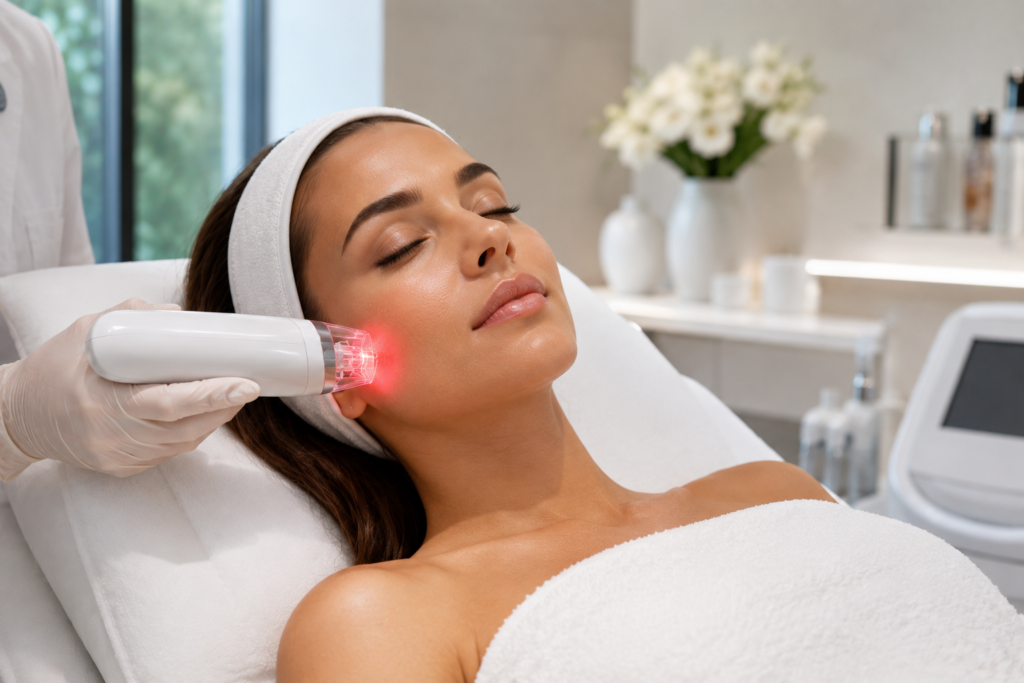
Treatment begins with a consultation, where a provider examines your skin, reviews your history, and confirms that resurfacing suits your goals. On the day itself, a topical numbing cream is applied and given time to take full effect. Your provider then passes the handpiece across the treatment area in a controlled pattern, delivering the laser energy in a measured grid.
Most clients describe the sensation as warm and prickling, and it is generally well tolerated once the numbing has settled in. A full facial session with Lutronic Ultra takes roughly 20 to 40 minutes, so the appointment fits comfortably into a working day.
What does recovery involve?
Expect your skin to look pink and feel warm for a day or two, comparable to a mild sunburn. Light flaking or peeling often follows a few days later as the treated cells shed and reveal the newer tissue underneath. That shedding is the visible half of the renewal process doing exactly what it should. Most people are comfortable returning to their usual routine within about 48 hours.
Two habits protect your investment during the weeks that follow:
- Apply broad-spectrum SPF every day and stay out of direct sun while fresh skin is forming, since new tissue burns and re-pigments easily.
- Set aside retinol and exfoliating acids for several days and let the peeling finish on its own rather than helping it along.
How long do the results last?
Surface brightness shows up first, often within the first week. The structural gains take longer, building across four to eight weeks as collagen remodels, and they continue to improve with each session in a series. Most clients reach their goals with two to four sessions spaced three to four weeks apart.
Once you have completed a series, the improvement generally holds for a year or more, though skin keeps aging and West Texas sun keeps doing its work, so periodic maintenance sessions preserve what you have gained. Daily sun protection remains the single most effective thing you can do to extend your results.
Who is a good candidate?
Non-ablative resurfacing suits clients who want a broad improvement in skin quality rather than one narrow correction, and who prefer meaningful change without a lengthy recovery. It works across a range of skin types, though your provider will assess your skin and calibrate the settings accordingly, since darker complexions require a more conservative approach to avoid pigment changes.
Timing matters as well. Because treated skin is sensitive to ultraviolet light, the cooler months are the easier window for a series. Active infections, certain medications, and recent sun exposure are all worth raising during your consultation, as any of them may shift the timeline.
How does laser resurfacing compare to other skin treatments?
Resurfacing is one instrument in a larger set, and the right choice follows from your primary concern. For skin laxity and pigment that sits deeper in the dermis, Sylfirm X RF microneedling in Abilene reaches further than a non-ablative laser can. For surface radiance with no downtime at all, a HydraFacial in Abilene delivers an immediate refresh. For controlled exfoliation of the outermost layers, medical-grade chemical peels cover similar ground through a different mechanism.
These treatments are frequently sequenced rather than chosen once and for all. A provider who understands how they layer can build a plan that addresses your concerns in a sensible order while giving your skin room to recover between appointments.
The short version Laser resurfacing clears damaged cells and rebuilds collagen, which shows up as brighter tone, faded sun damage, smoother texture, softer fine lines, and better hydration. Non-ablative systems like Lutronic Ultra deliver that improvement gradually over a short series, with roughly a day or two of downtime per session. |
Ready to see what your skin can do?
Laser resurfacing rewards good judgment about settings, timing, and skin type, which is why the expertise behind the device matters as much as the device itself. At Big Country Med Spa, our providers are trained in the nuances of laser treatment and build every plan around your skin rather than a standard protocol. To find out what resurfacing could do for you, call 325-400-6830 or book a consultation with our Abilene team.
References
Prospective Study of Efficacy and Safety of Non-Ablative 1927 nm Fractional Thulium Fiber Laser in Skin Photoaging. Frontiers in Surgery, 2023. https://www.ncbi.nlm.nih.gov/pmc/articles/PMC10025463/
Brauer JA, et al. Nonablative 1927 nm Fractional Resurfacing for the Treatment of Facial Photopigmentation. Journal of Drugs in Dermatology, 2014. https://pubmed.ncbi.nlm.nih.gov/25607696/
Investigating the Efficacy of a Fractionated 1927 nm Laser for Diffuse Dyspigmentation and Actinic Changes. Lasers in Surgery and Medicine, 2023. https://pubmed.ncbi.nlm.nih.gov/36950878/